Ah! My Goddess (1993 OVA)

Ah! My Goddess (1993 OVA)

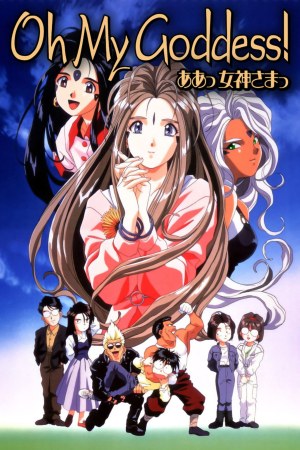
Oh My Goddess! / ああっ女神さまっ
1993 -1994 Anime International Company OVA 5 episodes Completed
Romance Comedy Fantasy Supernatural
Details & Synopsis
Keiichi Morisato is a technically gifted but chronically unlucky college student whose life changes when a wrong telephone number reaches the Goddess Relief Office. Belldandy appears in his room and offers him one wish. Convinced that the whole thing must be a prank, Keiichi asks for a goddess like her to stay with him forever. The wish is accepted, and the supernatural Ultimate Force makes backing out impossible.

The five-episode OVA turns that setup into a compact romantic fantasy about two people trying to make an impossible relationship feel ordinary. Belldandy brings warmth and patience into Keiichi's life, while her sisters Urd and Skuld arrive with very different ideas about what the couple needs. Love potions, magical system bugs, motorcycle races and divine rules keep intruding on college life, but the emotional center never moves far from Keiichi and Belldandy choosing each other again and again.

Produced by Anime International Company and released from 1993 to 1994, this was the first animated adaptation of Kosuke Fujishima's long-running manga. Its final two episodes create an OVA-specific climax around Belldandy's recall to Heaven, giving the short series a complete romantic arc even though the larger franchise continued for decades.
Alt Title Oh My Goddess! / ああっ女神さまっ
Studio Anime International Company
Network OVA
Aired 1993 - 1994
Episodes 5
Genre Romance, Comedy, Fantasy, Supernatural
Status Completed

Fansub & Scanlation History

Kōsuke Fujishima's Goddess Story Reaches Home Video

Monthly Afternoon · Kodansha · September 1988

Kōsuke Fujishima began publishing Ah! My Goddess in Kodansha's Monthly Afternoon in September 1988, several years before Belldandy and Keiichi reached animation. The manga established the Goddess Relief Office, the accidental wish that binds the two together, and the mixture of college romance, mechanical hobbies, and divine interference that would define the franchise.

Anime International Company brought the series to video on February 21, 1993. Directed by Hiroaki Gōda, the five-episode OVA continued through May 17, 1994. Its opening episodes drew from the manga's early material, while the final two developed an original conclusion built around Belldandy's possible separation from Keiichi.

For English-speaking fans, the anime arrived during a period when Japanese VHS imports and fan-subtitled tapes could reach conventions and anime clubs long before a commercial English release appeared.

The Original VHS Fansub Era

Three Episodes Subtitled for Anime Expo '93

Kiotsukete Studios · VHS-era fansubbing · Episodes 1–3

Kiotsukete Studios was already active in the American convention fansubbing scene when Ah! My Goddess appeared in 1993. The group prepared English subtitles for all three episodes available at the time for Anime Expo '93, alongside work on Tenchi Muyo!, Ranma ½, Koko wa Greenwood, and other titles.

The group's contribution is documented in Sean Leonard's historical study of early anime fan distribution. The work belonged to the original VHS era, when subtitled convention screenings and traded cassettes were often the only English-language access fans had to newly released anime.

Kiotsukete was closely connected to the conventions and clubs it served. Its members produced and duplicated tapes using professional video equipment, with copies reaching viewers through the growing anime-club network. The group's documented policy was to stop distributing a title once its American license became known.

Kiotsukete's documented run covers the three episodes available in 1993. A complete five-episode set under its name has not been established.

Nexus Studios Had Episodes 1–2

May 9, 1994 · VHS and S-VHS · Discontinued

Nexus Studios appears in a surviving May 9, 1994 Usenet fansubber directory. The group distributed VHS and S-VHS copies through registered members and anime clubs, with the stated purpose of increasing public awareness of Japanese animation.

Its catalog includes Ah! My Goddess episodes 1 and 2, but not among the group's available releases. Both episodes appear in the discontinued section, accompanied by an instruction not to request the titles because the tapes had already been erased.

That entry establishes that Nexus had handled the first two episodes by May 1994 and had already withdrawn them from its catalog. It does not establish the original subtitling date, identify the translator, or prove that every circulated copy had disappeared. It also does not establish whether Nexus created its own translation or distributed a version prepared elsewhere.

Nexus had already retired its copies before AnimEigo's first documented commercial VHS release that summer.

Arctic Animation: A Canadian Fansub Connection

William Chow · Vancouver, British Columbia · Documented May 1994

Arctic Animation provides another surviving record from the same period. Coordinated by William Chow in Vancouver, Canada, the group operated an extensive videotape distribution service covering anime films, television series, and original video animations.

Its May 9, 1994 catalog includes Ah My Goddess! under discontinued titles. Unlike Nexus, Arctic does not identify individual episode numbers in that entry. It shows that Ah! My Goddess passed through Arctic's catalog, although the episode count and original translation credit are absent.

Arctic's distribution records also reveal how physical the fansub network was. Viewers mailed blank tapes and return packaging, selected titles from group catalogs, and received duplicated recordings in the mail. This was a different world from downloading a finished episode from a tracker.

Both Arctic Animation and Nexus Studios still carried their discontinued Ah! My Goddess entries in the June 22, 1995 fansubber directory. The records preserve the names of two groups associated with the original VHS circulation, even though their tapes have not yet been positively identified in surviving digital archives.

The Official English Releases

AnimEigo Brings the Five-Episode OVA to North America

June 29 – August 31, 1994 · Official VHS

AnimEigo licensed the original Ah! My Goddess OVA for North American release and brought all five episodes to VHS between June 29 and August 31, 1994. The series was offered in both Japanese-language editions with English subtitles and English-dubbed editions.

The timing was unusually tight. The fifth Japanese OVA episode had been released in May 1994, and the North American commercial release began the following month.

AnimEigo's production credits identify Robert Woodhead as executive producer, Shin Kurokawa and Michael House among the English subtitling translators, and Coastal Carolina personnel responsible for the English dub.

This was the major transition in the title's English-language history. The anime that had reached viewers through convention screenings, fan subtitles, and circulating VHS copies was now available through an official home-video distributor.

The first fansub activity and the official release were barely a year apart, a remarkably quick transition for the early 1990s. Whether each group stopped because of AnimEigo's license is less clear.

Dark Horse Brings the Manga to English Readers

August 1994 · Dark Horse Comics · Studio Proteus

The original manga also received an official North American release in 1994. Dark Horse Comics began publishing Oh My Goddess! in August, working with Studio Proteus and translator Toren Smith.

The earliest English issues appeared in the American comic-book format, rather than the Japanese collected-volume format later associated with manga publishing. Dark Horse's release continued for years, eventually transitioning toward editions that more closely reflected the original Japanese publication.

No named pre-1994 English scanlation group has surfaced for Ah! My Goddess. Unlike manga that had to wait years for a publisher, it already had a commercial English edition during the earliest web-based fan-translation era.

Its documented early fan-translation history therefore belongs primarily to the anime, not to a confirmed manga scanlation movement.

Fujishima's Preference and the English-Language Title

AnimEigo's Original Translation Notes

The original Japanese title, Aa! Megami-sama, appeared with the English wording Ah! My Goddess in Japanese promotional material. When the manga and OVA were prepared for English-language publication, a different translation became established.

AnimEigo's surviving liner notes explain that the wordplay connecting Oh My Goddess! with the familiar English expression "Oh my God!" was brought to creator Kōsuke Fujishima's attention. According to those notes, Fujishima expressed a preference for the translated title Oh My Goddess!.

AnimEigo and Dark Horse used that English-language title for their early North American releases. The franchise later appeared under Ah! My Goddess again, including Pioneer's release of the 2000 theatrical movie.

The two English names became part of the franchise's distribution history. They refer to the same original work, but their appearance on different tapes, discs, and catalogs can help distinguish individual releases and licensing periods.

From DVD to Digital Archives

Official DVD Releases Replace the VHS Originals

AnimEigo · 2001 DVD releases · 2006 Remastered Collector's Edition

AnimEigo continued distributing the OVA after its original VHS run, including LaserDisc editions during the 1990s and two DVD volumes in 2001. A remastered collector's edition followed in 2006.

By the early 2000s, the series was reaching a different generation of anime fans. Instead of relying on exchanged videotapes, viewers increasingly encountered the five episodes through DVDs, digital encodes, and online file-sharing communities.

That shift can make old release credits misleading. A digital file carrying a fansub group's name was not necessarily copied from one of the original 1993 or 1994 fan-subtitled tapes. It may instead use a later commercial DVD, a Japanese home-video source, or an official subtitled VHS release.

AniDB Records the Early Digital Groups

2002–2005 · DVD and VHS Sources · Five-Episode Releases

AniDB's surviving release records document multiple digital groups associated with the original five-episode OVA. The database shows a complete DVD-sourced entry for zx with a last-update date of December 29, 2002, followed by other early entries including AlphaAnime in 2003.

One especially interesting entry is A-E, recorded with five complete episodes, a VHS source designation, and a last-update date of January 8, 2005.

The VHS designation makes that entry worth investigating. It suggests that a videotape source was used for the digital release, but does not identify the tape's origin. It could represent an official VHS edition rather than a surviving early fansub, and the available record does not connect it to Kiotsukete Studios, Nexus Studios, or Arctic Animation.

Those dates mark AniDB's catalog history, not necessarily the day each release first reached fans.

These early digital entries preserve a second generation of the OVA's distribution history, distinct from the original 1993–1994 videotape fansubs.

Zhentarim DivX / zx

DVD source · AniDB updated 2002
AniDB records a complete five-episode DVD-sourced entry under zx, with a last-update date of December 29, 2002. The date comes from AniDB's last-update field rather than a surviving first-release announcement.

AlphaAnime

Digital record · 2003
AlphaAnime appears among the early AniDB entries for the original five-episode OVA. The catalog record belongs to the digital era, and does not establish a connection to the original 1993–1994 fansub tapes.

Anime-Empire / A-E

5/5 episodes · VHS source
AniDB catalogs a complete A-E set with VHS listed as its source and January 8, 2005 as its last-update date. The tape could have been a commercial VHS release. There is no confirmed lineage to Kiotsukete, Nexus, or Arctic Animation.

An Exact Deadline for the Original OVA

February 28, 2010 · 11:59:59 PM Eastern

AnimEigo's North American license for Oh My Goddess! expired at the end of February 2010. This is confirmed directly by the distributor's archived February 22 announcement, which identified February 28 at 11:59:59 PM Eastern as the expiration deadline.

AnimEigo had already announced its approaching loss of the title on February 2, reducing prices on remaining DVD stock as the deadline approached.

By that point, the company had carried the original five-episode OVA through VHS, LaserDisc, DVD, and remastered DVD editions over more than fifteen years.

The expiration ended AnimEigo's licensed distribution of the series. It did not place the animation in the public domain, and it should not be confused with the licensing histories of the later theatrical film or television adaptations.

What Remains of the Original VHS Fansubs

The original Ah! My Goddess OVA occupies an unusually compact place in English-language fansub history. Kiotsukete Studios had subtitled three episodes for Anime Expo in 1993. By May 1994, Nexus Studios had cataloged and discontinued the first two episodes, while Arctic Animation had also withdrawn the title from its catalog. AnimEigo began releasing the official English VHS editions only weeks after the Japanese series concluded.

The names survive more clearly than the original tapes. No complete, positively identified set of these early fansub editions has yet been established in the evidence gathered for this archive. The exact translation lineage between Kiotsukete, Nexus, and Arctic Animation also remains unknown.

What survives is enough to document the transition. Ah! My Goddess entered American anime fandom through the same conventions, clubs, and videotape networks that helped establish early fansubbing. Within a year of its first OVA episode, it was moving toward an official North American release, with its manga following close behind.

The original VHS fansubs remain an important part of that history, not because they are known to have survived intact, but because the period records establish that they existed and show how quickly the English-language anime market was changing.