
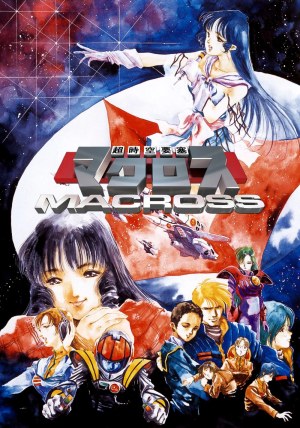
Super Dimension Fortress Macross

Super Dimension Fortress Macross

超時空要塞マクロス
1982 -1983 Tatsunoko Production / Studio Nue MBS 36 episodes Completed
Action Mecha Sci-Fi Romance Musical
Details & Synopsis
In 1999, an alien warship crashes on a remote island and humanity spends a decade reverse-engineering technology it barely understands. In 2009, the ship, rebuilt and renamed the Macross, launches on its maiden voyage. The aliens it came from show up the same day to reclaim it. What follows is a two-year war fought across the solar system, inside a city-sized battlefortress, between a civilization of giant humanoids and a species of smaller ones who discovered something the Zentradi never had: culture.

Produced by Tatsunoko Production and Studio Nue, Super Dimension Fortress Macross aired on MBS from 1982 to 1983. Thirty-six episodes that invented conventions the mecha genre is still running on today. The love triangle between ace pilot Hikaru Ichijyo, pop idol Lynn Minmay, and officer Misa Hayase is still being argued about. The variable fighters, transforming from jet to humanoid to attack mode, set a template that Transformers would borrow and Gundam would spend decades trying to answer. The moment a song stops a war is still one of the most quietly radical ideas ever animated.

In the West, Macross was chopped up, merged with two unrelated series, and released as Robotech in 1985. Harmony Gold then spent thirty years using that license to block official Macross releases outside Japan. Fans distributed fansubs of the original specifically as an act of reclamation. The history of how Westerners actually saw this show is inseparable from the history of fansub culture itself.

Watch the original. Watch Do You Remember Love? immediately after. Then watch Macross Plus and understand why Shinichiro Watanabe made Cowboy Bebop the way he did.
Alt Title 超時空要塞マクロス
Studio Tatsunoko Production / Studio Nue
Network MBS
Aired 1982 - 1983
Episodes 36
Genre Action, Mecha, Sci-Fi, Romance, Musical
Status Completed

Character Arcs & Triangle

Hikaru Starts as a Civilian Pilot Who Wants No Part of the War

Air racer · Roy's junior · reluctant soldier · squadron leader

Hikaru Ichijyo arrives at South Ataria Island as a talented civilian pilot more interested in flying than military life. The Zentradi attack drops him into a war he did not choose, and his connection to Roy Focker eventually leads him into the UN Spacy.

He becomes a capable combat pilot and later a leader, but Macross never completely erases the civilian who existed before the uniform.
Why it matters
Hikaru's growth is not simply learning to fight better. The series keeps asking what kind of life he wants once survival is no longer the only question.

Command Makes Hikaru Responsible for More Than His Own Survival

SPOILER!

Vermilion Squadron · lost comrades · postwar duty

As Hikaru advances, Max and Kakizaki become his subordinates and the war stops being something he experiences only from his own cockpit.

Loss changes the meaning of command. After the main war ends, military life changes again as Hikaru patrols a damaged Earth where peace has not made every Zentradi willing or able to stop fighting.
Why it matters
The postwar episodes matter because Hikaru has already become good at being a soldier. He now has to decide whether being a soldier is enough of a future.

Misa Is Good at Her Job Before Hikaru Learns to See Her

Bridge officer · disciplined command · friction becomes trust

Misa Hayase is one of the senior officers directing flight operations aboard the Macross. She begins the series disciplined, formal and frequently exasperated by Hikaru's behavior.

Their relationship changes through repeated work, danger and disagreement rather than one sudden romantic turn. Hikaru gradually sees the person behind the officer, while Misa allows more of herself to exist outside duty.
Why it matters
Misa does not become important because Hikaru eventually loves her. She is already one of the people holding the Macross together.

Misa's Future Is Bigger Than Waiting for Hikaru to Decide

SPOILER!

Postwar reconstruction · colonization plans · a life beyond the triangle

In the final stretch, Misa is offered a leading role in humanity's future space-colonization effort.

That opportunity matters because it gives her a direction that does not depend on Hikaru resolving his feelings. When the triangle finally breaks, Misa is already prepared to move forward with or without him.
What changed
The ending does not reward Misa for waiting patiently. It makes Hikaru confront the fact that she has a future he can either choose to share or lose.

Minmay Becomes an Idol Almost by Accident

Macross City teenager · Miss Macross · singer · face of human culture

Minmay begins as a teenager whose family runs a restaurant inside the civilian city carried aboard the Macross.

Winning the Miss Macross contest pushes her into entertainment, and her popularity grows until her songs and image are everywhere aboard the ship. None of this begins as a military plan.
Why it matters
Minmay becomes strategically important because the Zentradi have never encountered a life in which singing, romance and entertainment matter. The military value comes after the human thing already exists.

Fame Gives Minmay an Audience Without Giving Her a Home

SPOILER!

Celebrity · Kaifun · postwar isolation · choosing to keep singing

Minmay's success keeps expanding while her personal life becomes harder to hold together.

Her career separates her from Hikaru, her relationship with Kaifun becomes increasingly painful, and the postwar world eventually leaves her searching for the familiarity she once took for granted.
Why it matters
The final episodes refuse to freeze Minmay as the perfect idol from the middle of the series. She has to discover what singing means when fame, romance and survival are no longer pointing in the same direction.

Hikaru Loves an Idea of Minmay Before He Understands Misa

SPOILER!

Longing at a distance · intimacy through shared life

Hikaru's feelings for Minmay grow around attraction, missed timing and the image of a life that keeps slipping away from him. The more famous she becomes, the easier it is for their relationship to exist partly as longing.

His bond with Misa develops differently. They work together, argue, rescue one another, disappoint one another and spend enough time together to see each other without much illusion left.
Why it matters
The triangle works because neither relationship is fake. Hikaru's final choice comes after the series has spent years of story time showing him the difference between wanting a possibility and building a life with someone.