9/10Cult Pick

Animehistory Review's - Vampire Hunter D: Bloodlust.
Vampire Hunter D: Bloodlust begins like a kidnapping story and spends the next hundred minutes proving that almost everyone misread the kidnapping.Charlotte Elbourne is gone. The vampire Meier Link took her from her home in the night, her wealthy family wants her back dead or alive, and they will pay an absurd sum to make it happen. The legendary hunter D takes the job, while the Marcus Brothers take the same bounty and turn the rescue into a race. That's the story everyone thinks they're in.
Then Charlotte throws herself into Meier's arms. She wasn't waiting to be rescued. She loves him.
That one complication turns what could have been a beautifully animated monster hunt into something far more interesting. Bloodlust is still full of vampires, mutant assassins, exploding bodies and haunted castles, but underneath the gothic machinery is a surprisingly simple tragedy about people who have already decided what a monster looks like.
From Demon Deathchase to Bloodlust
Bloodlust adapts Demon Deathchase, the third novel in Hideyuki Kikuchi's long-running Vampire Hunter D series. It wasn't the first attempt to animate D. The 1985 Vampire Hunter D film had already introduced anime audiences to Kikuchi's far-future frontier and the half-human, half-vampire hunter wandering through it. Fifteen years later, Madhouse came back with Yoshiaki Kawajiri, and that matters.Kawajiri had directed Wicked City, another Kikuchi adaptation, and Ninja Scroll, and Kikuchi's world is almost perfectly built for his instincts. It is part Hammer horror, part Western, part post-apocalyptic science fiction. Ancient castles rise over wastelands crossed by mechanical horses. Vampires live beside machinery advanced enough to reach space. Mutants hide in shadows and fold their bodies into the scenery, while D rides through all of it looking like someone dropped a Yoshitaka Amano illustration into a Clint Eastwood movie.
Kawajiri wrote and directed the film, and Yutaka Minowa translated Amano's illustrations into animated character designs. It was made as a co-production with the American distributor Urban Vision, with the animation done at Madhouse in Tokyo and post-production handled in California. An anime feature built for an international audience from the start was far less common in 2000 than it is now. Bloodlust is designed to be stared at.
The world after the vampires
The clever thing about Bloodlust's setting is that the vampires have already lost. The Nobility once ruled this world. Their technology is still scattered across it, their castles still tower over the landscape and ordinary people are still terrified of them, but their age is ending. Hunters exist because humanity is taking back ground that once belonged to creatures like Meier Link.D lives directly between those worlds. He is a dhampir, a "dunpeal" in the film's English, born to a vampire father and a human mother. Humans hire him because he kills vampires better than they can, then recoil from him because he carries the same blood as the things they fear.
The film never needs D to explain how lonely that is. It's built into every room he enters. People stare at him. Other hunters treat him as competition, not company. Vampires recognize what he is but don't count him as one of their own. Even his body is divided, complete with the wisecracking parasite living in his left hand. D belongs everywhere just enough to be useful, and nowhere enough to stay.
That makes Charlotte and Meier more than another job. Their relationship drops D into a situation where the clean line between human victim and vampire monster stops working.
Charlotte was not kidnapped
The movie first encourages us to believe what Charlotte's family believes. Meier is a powerful vampire, Charlotte is a young human woman, and he came for her at night. Case closed. Except Meier keeps refusing to act like the predator the story needs him to be.Charlotte doesn't fear him. She fights to get back to him when the hunters separate them. When Meier is badly burned shielding her, she holds him through it. Later, recovering, he comes dangerously close to biting her and deliberately pulls away. The bloodlust in the title isn't just a cool word on a vampire movie. It's the thing Meier has to resist if his love for Charlotte is going to mean anything.
That makes the romance far more interesting than the family who hired D ever imagined. Meier really is dangerous, and the humans aren't irrational for fearing him. They're simply wrong about what Charlotte wants. She chose him, and because nobody believes that choice could be genuine, nearly everyone in the film spends the next hour trying to save her from it.
The other hunters
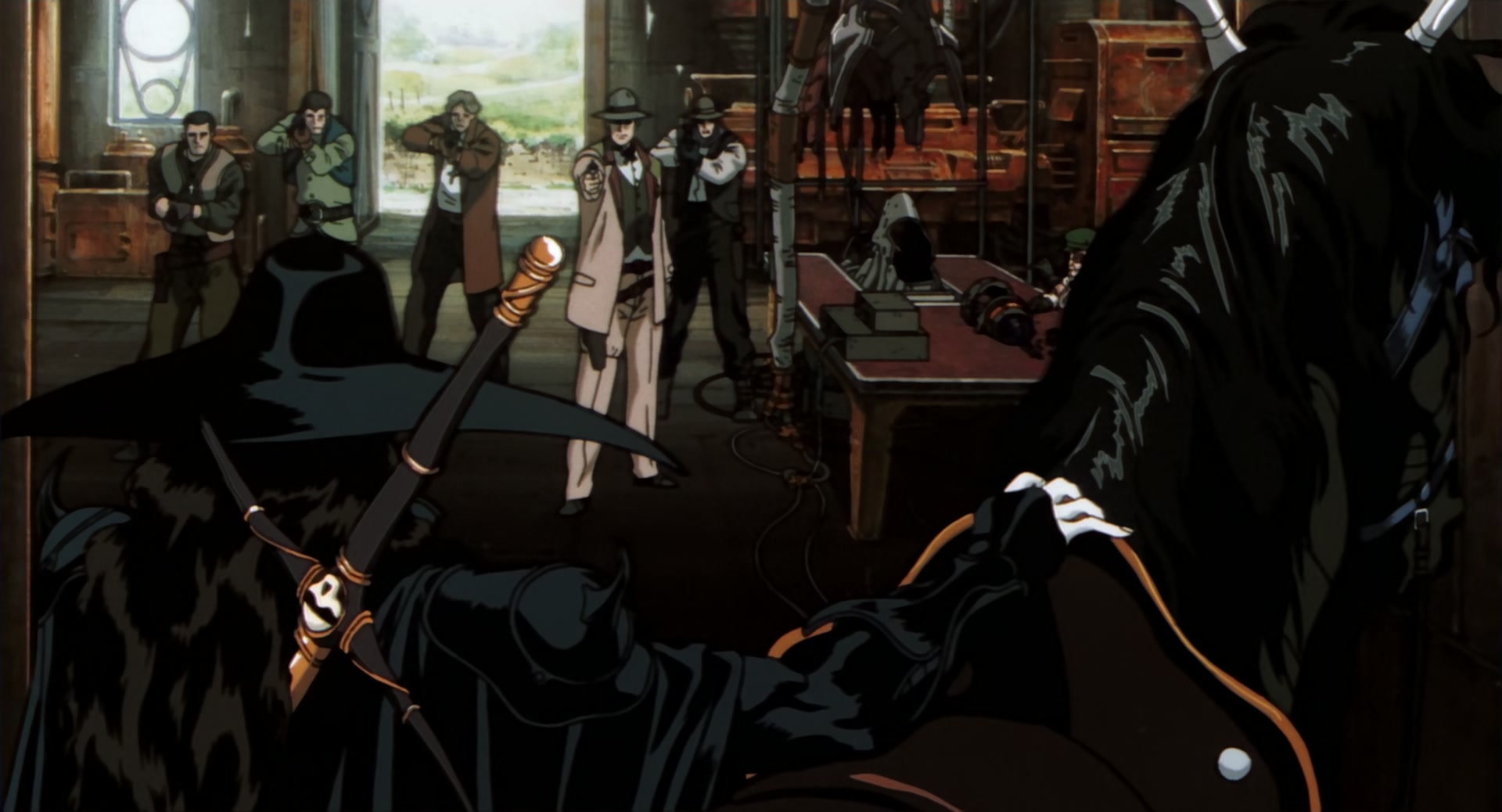
D isn't the only one chasing the carriage. The Marcus Brothers give Bloodlust something it needs: hunters who are unmistakably human and much messier than its half-vampire lead. Borgoff leads, with Kyle, Nolt, Grove and Leila filling out a crew whose methods run from professional to suicidal. They are loud where D is quiet, aggressive where he is patient, and far more willing to treat the job as exactly what the Elbournes paid for: bring Charlotte back and collect.They also die. The deeper the chase goes into the supernatural, the more the team is taken apart by the Barbarois, the mutants protecting Meier. Benge hides inside shadows and strikes through them. Caroline merges with the landscape around her. Mashira is a werewolf, and his fight with D barely needs dialogue because the film knows how cool a werewolf fighting a vampire hunter already is. Each encounter gives Madhouse another excuse to show off, and each death leaves Leila closer to where D already stands. Alone.
D and Leila
Leila's hatred of vampires is personal: when she was a child, one took her mother. She built a life around hunting the thing she believes destroyed her family. D built one too. The difference is that he can't put distance between himself and vampires. The thing she hates is literally part of him.Their relationship starts in distrust and grows without becoming a romance. After D saves her and the two shelter from the rain, she recognizes something familiar in him: both have spent so long hunting that neither expects anyone to be waiting when they finally die. So they make a deal. Whoever dies first, the other will visit the grave.
It's a small scene in a movie full of enormous castles and impossible monsters, and it quietly becomes the most important promise in the film. Unlike nearly everyone else chasing Charlotte, Leila actually changes. Watching Meier and Charlotte together forces her to admit that hatred learned through tragedy can still be wrong.
Then the movie finds a bigger vampire
Everyone eventually reaches the Castle of Chaythe, and Bloodlust stops pretending it's the end of a chase movie and goes fully gothic. Waiting inside is Carmilla, the ghost of a vampire countess, who offers Meier and Charlotte what they have been running toward: passage to the City of the Night, a vampire refuge beyond the hostile human world.Naturally, the ancient countess haunting a nightmare castle isn't being honest. Carmilla needs Charlotte's blood to escape her ghostly form and return to life. Carmilla manipulates instead of loving. She builds visions out of grief and desire, attacking Leila through memories of her family and trying to unsettle D with the image of his mother. Borgoff fares much worse. By the time the castle starts coming apart, the rescue mission from the opening has collapsed completely. Charlotte doesn't need rescuing from Meier. She needs rescuing from the vampire who claimed to understand them both.
The most beautiful thing in the movie is movement
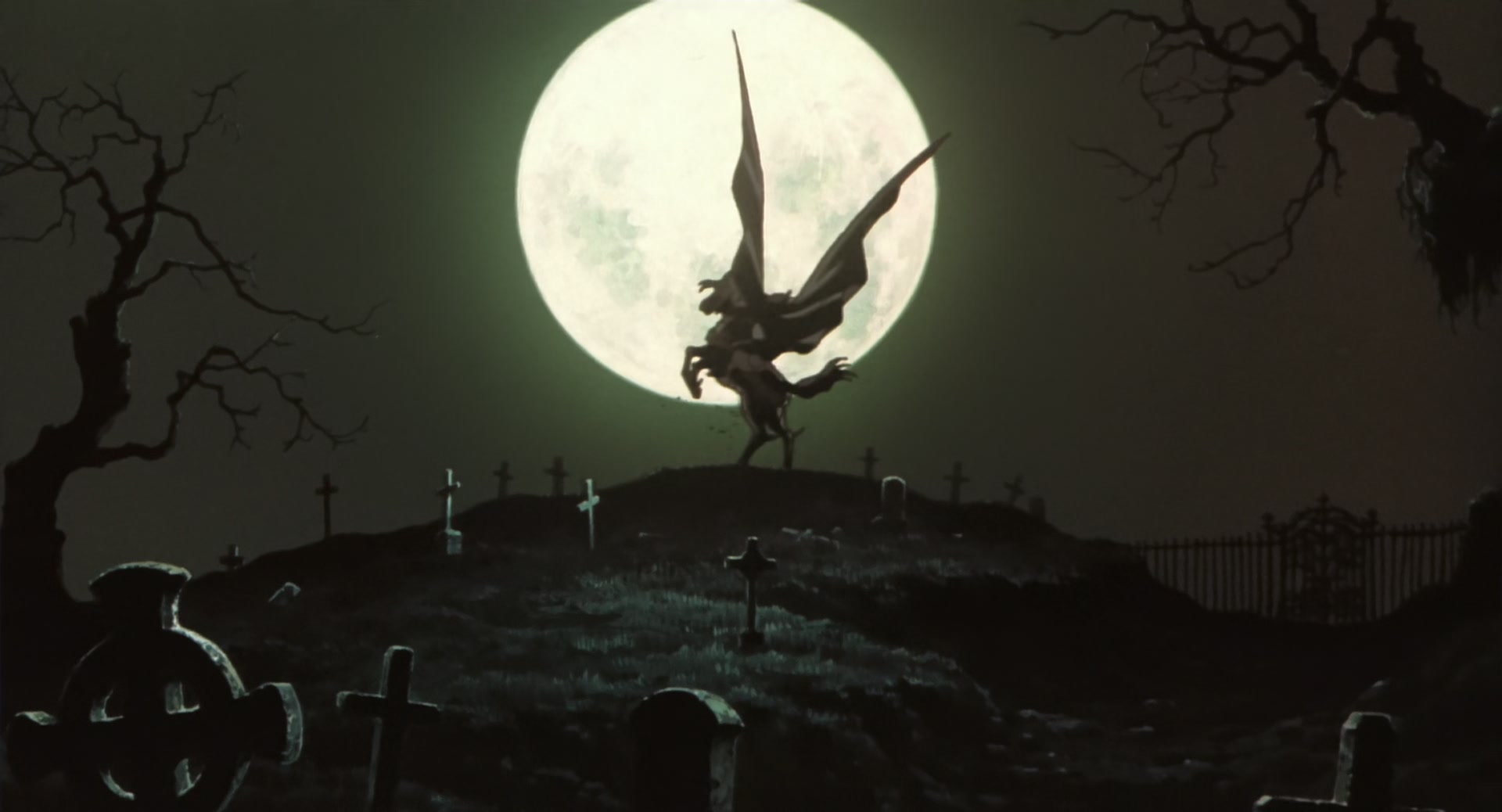
You can freeze Bloodlust almost anywhere and get a beautiful image. The backgrounds are enormous, the silhouettes are unmistakable, and D's design lets Kawajiri set an impossibly thin figure against the moon, a castle or an empty horizon again and again. But detail isn't the only reason it still looks so good. It's movement.D's coat follows his sword through every strike. Meier's carriage feels genuinely fast. Characters cross huge spaces instead of being pasted in front of them, and horses, capes, dust, shadow and debris keep giving the world physical weight. The bridge attack is probably the best showcase: the Marcus hunters hit Meier's carriage at speed, explosives tear the bridge apart while the horses keep running, and Meier burns in the daylight trying to reach Charlotte. The sequence has nothing to prove except that animation can do this, and twenty-six years later it still looks extraordinary.
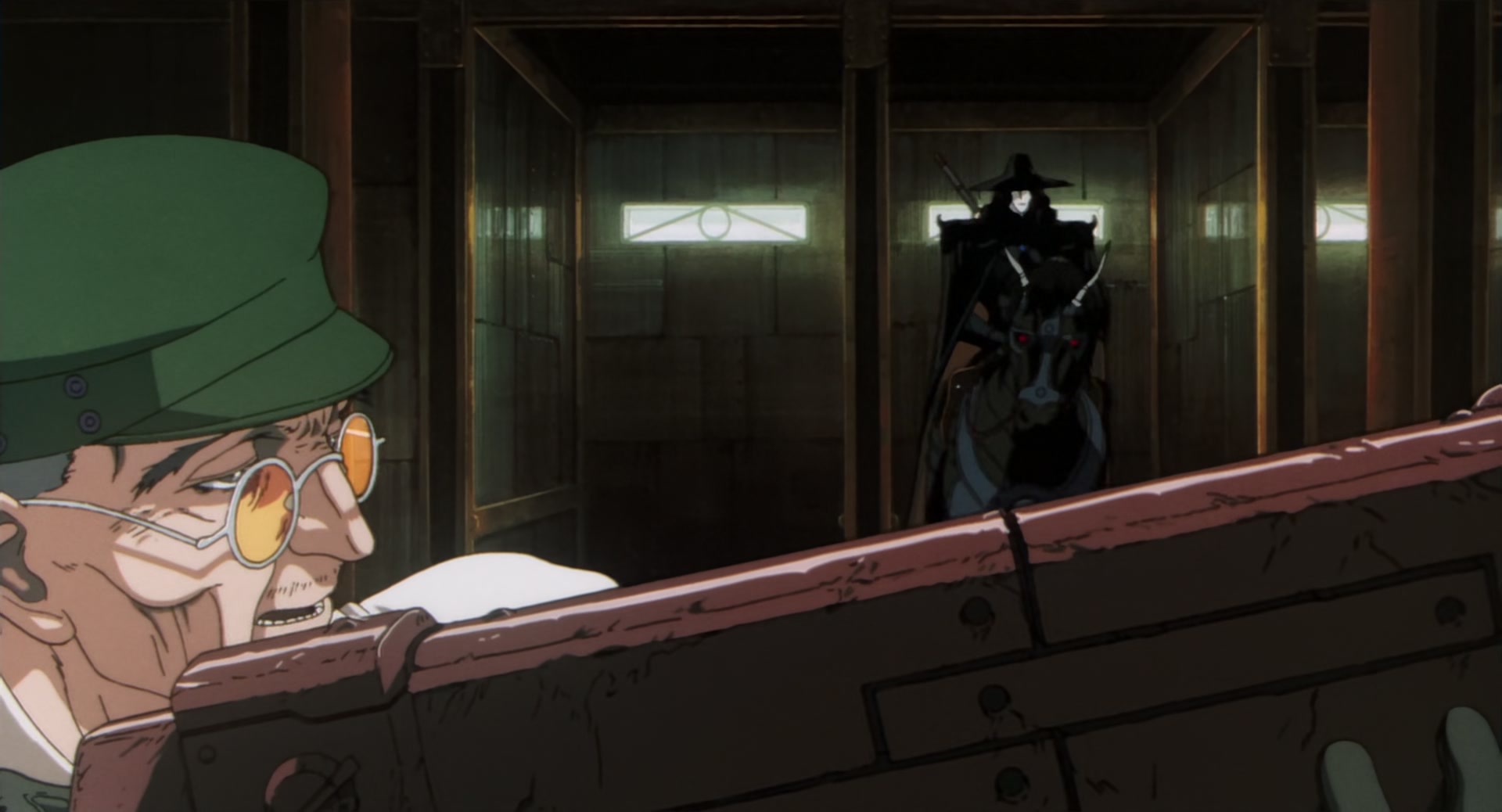
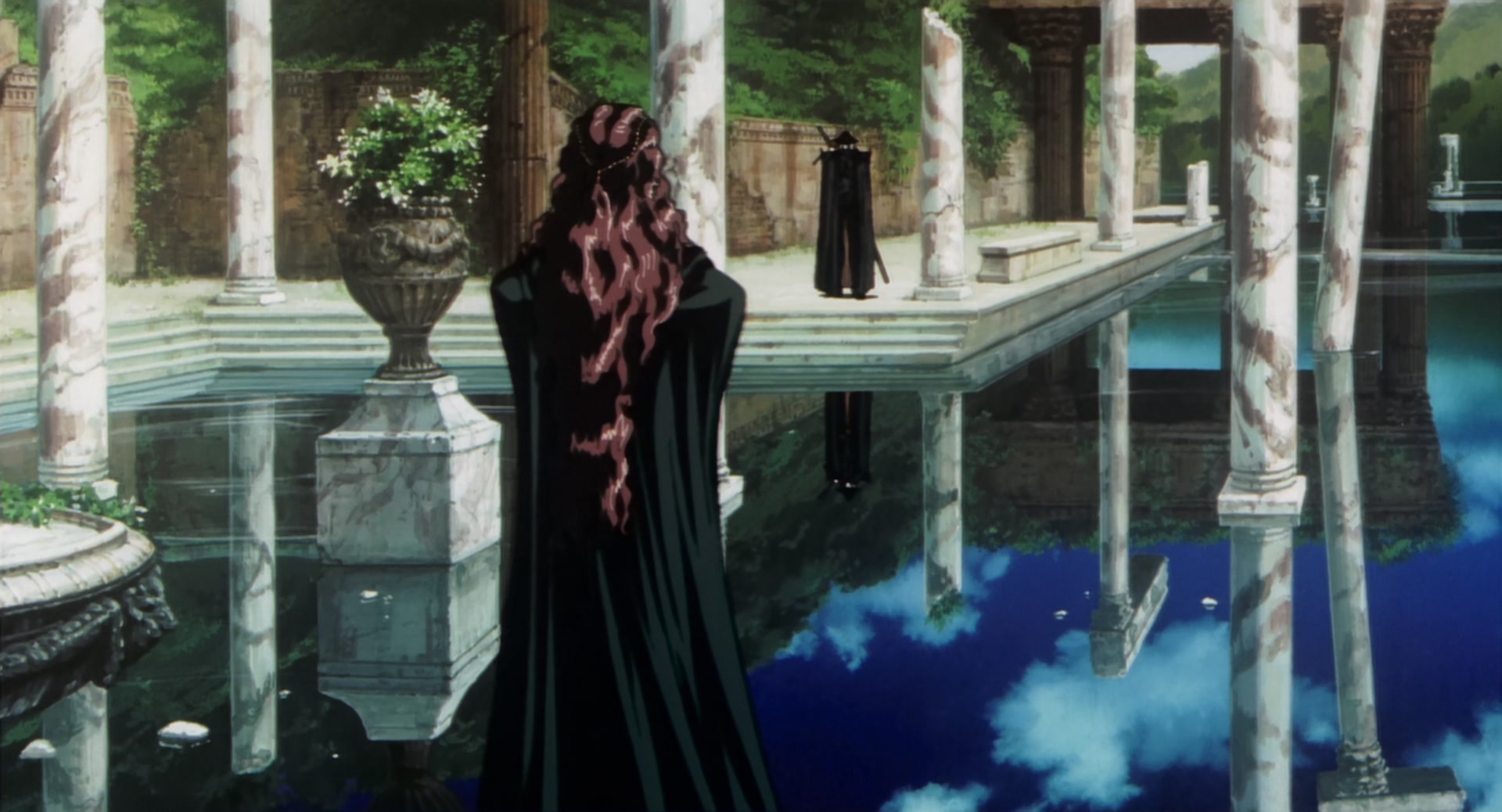
That matters, because Bloodlust's plot is sometimes more functional than profound. Characters arrive because the chase needs another obstacle. The Barbarois are memorable as designs before they're memorable as people. Carmilla shows up late and more or less hijacks the final act. The movie gets away with it because Kawajiri knows exactly what kind of film he's making. This is gothic pulp. It's supposed to look impossibly cool.
An anime that reached Japan in English
The strangest part of Bloodlust's history is its soundtrack. Calling the English track a "dub" gets the production order backwards. The English dialogue was recorded in Los Angeles in 1999, before the Japanese dialogue was finished, and the completed film was released theatrically in English only. When Bloodlust opened in Japan on April 21, 2001, audiences watched the English version with Japanese subtitles. The Japanese voice track came later, for the Japanese home release. A Japanese anime was effectively imported back into Japan.American fans met it early. A two-and-a-half-minute trailer was already playing at U.S. anime conventions in 1998. The film premiered at Montreal's Fantasia festival in July 2000, screened that October at the New York Anime Film Festival, and opened in American theaters on September 23, 2001. Urban Vision released it on DVD and VHS on February 12, 2002, and that DVD was English only. No Japanese track, no subtitled option.
So why were there fansubs?
This is where Bloodlust becomes especially useful for the history this site tries to preserve. The full trail is on the Vampire Hunter D: Bloodlust Fansub & Release History page, but the short version is that English fan releases kept appearing even though an official English soundtrack and a commercial American DVD already existed.AnimeReactor holds the earliest English digital fan release in our surviving record, dated October 8, 2003, sourced from DVD. Then came a pile-up: Anime-4ever on January 15, 2004, Anime-Xtreme ten days later, and AlphaAnime the day after that. Three competing releases of the same movie in eleven days. AnimeUnion, I Love Anime, Hanako and Anime HQ kept the film circulating through 2006.
That sounds pointless if fansubs exist only to translate anime companies won't release. But that was never the whole story. By the mid-2000s, fan distribution was also about encode quality, preferred scripts, alternate language tracks and keeping older titles moving through the networks. And Bloodlust had a very specific gap. The Japanese performance isn't just the English script read in another language; the two tracks diverge enough that some explanations and emotional beats land differently. Japanese DVDs carried both, but every North American release stayed English only. An anime that first reached English speakers in English could only be heard in Japanese, here, through fans subtitling it back into English.
Anime distribution history is ridiculous sometimes. 😛
The ending understands D
Carmilla loses. Charlotte doesn't survive. Meier does. D could still finish the job as it was given to him; Charlotte's family wanted her back dead or alive, and Meier is still the vampire who carried her off. Instead, the fight between D and Meier ends without D killing him, and D takes Charlotte's ring as proof for her family. Meier carries Charlotte onto the castle's ship and leaves for the City of the Night anyway, taking the woman he loved even though the future they imagined is already gone. Leila, the woman whose life was built on hating vampires, watches him go and hopes he makes it.That would be enough. Then Bloodlust jumps forward decades, and D arrives at a funeral. Leila kept living. She built a family, grew old and died surrounded by enough people that the fear she confessed under that tree never came true. Her granddaughter recognizes him from the stories and invites him to stay. D doesn't. Of course he doesn't. He came to keep a promise to an old friend who believed nobody would mourn her, and found her grave surrounded by people who loved her. For the gentlest moment in the entire movie, D smiles.
Why it still matters
Bloodlust could survive on aesthetics alone. It has D silhouetted against enormous moons, decaying vampire technology, ruined castles, biomechanical horses, mutant assassins and one of the coolest character designs ever animated. That's enough for a Halloween movie. It isn't why the film lasts.At the center of all that style is a story about people who decide they understand each other before bothering to ask. Charlotte's family sees a kidnapped daughter. The hunters see a vampire and his victim. Leila sees the species that destroyed her childhood. Meier sees a world that will never let his relationship exist. D sees all of them from the uncomfortable position of belonging partly to both sides and fully to neither.
The movie lets almost everyone be right about something. Vampires really are dangerous. Meier really could kill Charlotte if his hunger wins. Her family has every reason to be afraid, and Leila's hatred comes from real trauma. But none of those truths stop Charlotte from loving Meier, and that is what turns the chase into a tragedy.
Its biggest weakness is that it has so many monsters, ideas and pieces of worldbuilding that some exist mostly to be beautiful for five minutes and then die. The Barbarois could carry far more story than they get, Carmilla arrives late, and D is so deliberately restrained that Leila and Meier sometimes feel more emotionally open than the title character. I don't think any of that hurts the film much. D is supposed to feel halfway outside the human world already. Leila is the one who still has time to come back.
That's why the funeral matters. The movie opens on a family convinced a vampire stole their daughter and closes on a vampire hunter discovering that his friend built the human life she once thought was impossible. D keeps his promise. He sees the flowers, realizes Leila never needed his, and rides away.
Twenty-six years later
As of October 2026, Bloodlust is coming around again. In August, GKIDS announced at its Anime NYC industry panel that it had acquired the film's North American rights, with plans to return it to theaters in a new HD master and a full theatrical and home video release in 2027. The movie began as an unusually international anime production, circulated through festivals before most fans could own it, became an Urban Vision staple of early DVD shelves, lived for years in fan encodes, and now has another theatrical life waiting more than a quarter-century later. Some movies survive because somebody keeps remaking them. Bloodlust mostly survived because people kept looking at it and saying the same thing:Jesus Christ, this still looks incredible.
They're right.

Reviewing
Vampire Hunter D: Bloodlust
View anime detail →
