
Super Dimension Fortress Macross
7/10Classic
ESSENTIAL : Mecha Space Opera Idol Military Sci-FiLet me be upfront about something: if you grew up in the West watching Robotech, you didn't watch Macross. You watched a stitched-together Frankenstein of three unrelated Japanese shows that Carl Macek reverse-engineered into a single continuity because American TV syndicators needed 65 episodes minimum for daily broadcast. The show you actually want — the one that started everything — is this one. Super Dimension Fortress Macross. 36 episodes. Broadcast in Japan from October 1982 to June 1983. The real thing.
And it's better than Robotech. It's not even close.
What It Is.
Military sci-fi. Love triangle. Pop idol saves humanity from an alien armada through the sheer power of music. That's the pitch, and it sounds ridiculous until you're actually watching it and realize Sh?ji Kawamori wasn't joking — he was building a thesis.
The setup: a city-sized alien warship crashes on Earth in 1999. Humanity spends a decade reverse-engineering it, ends a worldwide civil war in the process, and christens the rebuilt ship the SDF-1 Macross. Then on launch day, a fleet of giant humanoid aliens called the Zentradi shows up. The ship's automated defense systems fire on them before anyone can stop it. War starts. The ship accidentally folds itself — and the entire civilian island it was docked on — to the edge of the solar system. Now 50,000 civilians are trapped inside a military fortress with a three-year trip home ahead of them, an alien armada in pursuit, and no good options.
That's episode three. The show moves fast.
The Love Triangle That Drives Everything
Kawamori described Macross as "a love triangle against the backdrop of great battles," and that framing matters. This isn't a war show with a romance subplot. The romance is the spine.
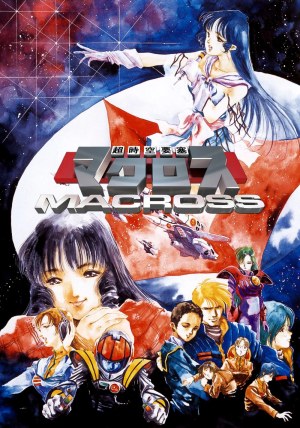
Hikaru Ichijyo is a civilian stunt pilot who stumbles into the military. Misa Hayase is a disciplined bridge officer, older, formal, carrying weight. Lynn Minmay is a teenage girl who wanted to be a pop star and is now the most important person in the galaxy without fully understanding why. The three of them orbit each other across 36 episodes and the show never lets you get comfortable with who Hikaru is going to choose. It doesn't rush it. It doesn't cheat. The resolution lands because the series earned it.
Western anime fans who only know this story through Robotech often say they preferred the original Japanese ending. They're right to. The Robotech localization softened the emotional beats and front-loaded romantic declarations that the original withholds deliberately. The restraint is part of the point.
The Zentradi Problem (Which Is Actually the Whole Point)
Here's what makes Macross more than a mecha show: the enemy isn't evil.
The Zentradi are a genetically engineered warrior race, created half a million years ago by a precursor civilization called the Protoculture — designed purely for war, stripped of everything else. No art. No music. Strictly segregated by sex. No concept of a kiss, a family, or an embrace. When Zentradi scouts observe humans doing any of these things, they have psychological breakdowns. They don't have the internal architecture to process it.
Minmay doesn't fight. She sings. Her music is broadcast across the enemy fleet during the final assault and it paralyzes them — not metaphorically. Literally.
The show calls this "culture shock" and then makes it the actual weapon that ends the war. It's a critique of absolute militarism wrapped in a pop song. The series argues, with a straight face, that a society with no culture is a society that has already lost — it just doesn't know it yet. That's a genuinely interesting idea, and the show commits to it all the way to the end.
The Animation Still Holds
Macross was made by young people. Kawamori and character designer Haruhiko Mikimoto were classmates at Keio. Some of the core staff were still in university during broadcast. That collegiate energy shows — not as inexperience, but as ambition. They were making the show they wanted to watch.
The standout is Ichir? Itano's combat animation. After some years away from the industry driving trucks, Studio Nue brought him in and he responded by inventing what the fandom now calls the "Itano Circus" — massive simultaneous missile volleys, chaotic contrail trails, a camera that moves like it's physically trying to keep up with supersonic objects. It replaced the static theatrical framing of earlier mecha anime with something that felt like three-dimensional space. Kinetic, disorienting, brutal. The VF-1 Valkyrie dogfights in this show still look good.
The technique showed up in Evangelion, got theorized as an influence on the aerial sequences in Top Gun (1986), and gets explicitly homaged in Western animation to this day.
Kentar? Haneda's orchestral score — performed by the Healthy Wing Orchestra — won the 1st Japan Animation Award in the Music Category. It earns it. He wrote a space opera score for a show that was also a pop idol story, and somehow both things are true at once.
Where It Gets Complicated in the West
You probably encountered this franchise as Robotech. That's fine. A lot of people did. Robotech was a genuine cultural moment in Western animation — it introduced a generation of American kids to serialized storytelling, character mortality, and unrequited love triangles in a medium that was otherwise giving them He-Man. For many people, it was the gateway drug for everything that followed.
But Robotech is also a Frankenstein. Harmony Gold producer Carl Macek needed 65 episodes for syndication. Macross gave him 36. So he licensed two completely unrelated Japanese mecha shows — Super Dimension Cavalry Southern Cross and Genesis Climber MOSPEADA — and rewrote everything to make them a single multigenerational saga. Protoculture, which in Macross is a philosophical and anthropological concept (the ancient precursor civilization), got redefined in Robotech as a magical bio-energy resource that everyone's fighting over.
Harmony Gold then spent the next twenty-plus years asserting that their original licensing deal gave them international trademark rights over the entire Macross franchise — not just the original series footage, but all sequels, prequels, merchandise, games. Japanese courts ruled definitively in the early 2000s that they were wrong. Harmony Gold registered Western trademarks anyway and enforced them aggressively. The result was that while the Macross franchise kept expanding in Japan through the 90s and 2000s, Western audiences got nothing. Fan subs and gray-market imports only.
In 2021, Big West, Studio Nue, and Harmony Gold finally reached a settlement. In 2024, the sequels started hitting Disney+ internationally. The original series and Do You Remember Love? are still Japan-only due to the residual Robotech licensing — but everything else is finally accessible.
The Verdict
Macross is a foundational work. Not because of the mecha — though the VF-1 Valkyrie is genuinely one of the great mechanical designs in anime history — but because of what it argues. That culture is survival. That music is a weapon. That a society without art is already a casualty before the war starts.
The love triangle is real and it resolves honestly. The animation holds up in the ways that matter. The villain isn't evil, just empty, which is worse. And the finale earns the weight it carries.
If you only know this story through Robotech, you know a good adaptation of a great show. Watch the original.
Reviewing
Super Dimension Fortress Macross
View anime detail →
~ edited May 9, 2026