
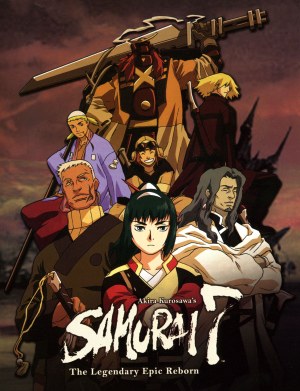
The Seven Samurai 50th Anniversary Starting Point
1954 film · 2004 anime · Same mission, rebuilt world
Samurai 7 was produced in 2004 as a science-fiction reworking of Akira Kurosawa's 1954 Seven Samurai during the film's 50th-anniversary year.
The anime keeps the village, the rice payment, the seven samurai and many recognizable character functions, then expands the story into a twenty-six-episode world of mechanized war, merchant cities and imperial power.
Why it matters
The movie is the blueprint, not homework. A basic familiarity with the original setup is enough to see what the anime is preserving and what it is deliberately rebuilding.
Rice Is Payment, Harvest and Political Leverage
Food first · Reward second · Resource everyone wants
Rice is Kanna's food supply, its payment to the Seven and the resource the
Nobuseri return to steal.
The series does not need rice to be a universal official currency for it to control the story.
Why it matters
The same grain means survival to farmers, compensation to hungry samurai and loot to the forces exploiting the countryside. Samurai 7 keeps returning to rice because every class in the story assigns it a different kind of value.
Gonzo's Hybrid 2D/3D Samurai 7 Look
Digital HD production · Drawn characters · CG machinery
Samurai 7 was built around a deliberately mixed visual world: hand-drawn characters and sword action share the screen with large digital machines, ships and environments.
The contrast can be obvious, especially by modern standards, but it is also part of how the anime sells an impossible scale difference between human swordsmen and mechanized war.
Why it matters
The technology is not only production trivia. The visual mismatch helps make the Seven look small, fast and stubbornly human against weapons built on an industrial scale.