
Featured

Reviews Page 2

Cowboy Bebop, Session 5: "Ballad of Fallen Angels"

The first four sessions of Cowboy Bebop show you what the series looks like. "Ballad of Fallen Angels" is the first to show you what it is hiding. Until now, Spike Spiegel has been easy to read. He is lazy, sarcastic, absurdly good in a fight and happy to drift wherever the next bounty points. Jet knows his partner does not talk about his past, but the show has given us little reason to push. Then the Red Dragon Crime Syndicate starts eating itself, and the lazy bounty hunter routine stops explaining Spike at all.

Originally broadcast on WOWOW on November 20, 1998, Session 5 was written by Michiko Yokote, storyboarded by series director Shinichirō Watanabe and directed by Tetsuya Watanabe, with Toshihiro Kawamoto serving as animation director. Those credits matter because this is the first episode where Cowboy Bebop's style stops being decoration and becomes character.

A bounty that isn't about money

Mao Yenrai, an important figure from Spike's old Red Dragon life, has arranged a truce with the rival White Tiger syndicate. Vicious has no interest in peace. The White Tiger delegation is wiped out and Mao is murdered. When the bounty reaches the Bebop, Spike recognizes the name immediately, and for once the money barely matters.

Jet notices. Their argument is one of the first times the series lets us see how little these two men actually know about one another. Jet asks what Mao meant to Spike, and Spike answers by asking Jet how he lost his arm. Message received: you keep your ghosts, I'll keep mine. Neither man explains himself, and that refusal matters. Cowboy Bebop is not interested in opening Spike's file and reading his biography aloud. It begins revealing him through the things he refuses to say.

A man who already died

Spike visits Annie, an old acquaintance from his Red Dragon days, and the mood shifts the moment he walks through her door. Annie does not greet him like an old friend who has come home. To her, Spike died years ago, and Spike has to insist that he is standing right in front of her. That small exchange gives "Ballad of Fallen Angels" its real subject: is Spike Spiegel actually alive?

Read more →

Naruto Shippuden Episode 82: Team Ten

There is very little in "Team Ten" that sounds impressive on paper. Naruto is barely relevant to the episode. No new technique is introduced, no Akatsuki member is defeated, and almost no action takes place at all. For most of its runtime, Shikamaru walks through Konoha, sits quietly, plays shogi with his father and tries to come to terms with the fact that Asuma is dead.

That simplicity is exactly why Episode 82 works.

Aired in Japan on October 30, 2008, Team Ten arrives immediately after one of the Hidan and Kakuzu arc’s defining events. Asuma has been killed, Team 10 has returned home without its teacher, and the story has reached the uncomfortable point where everyone has to continue living after the battle is over. The manga provides the essential events, but the anime makes a deliberate choice not to hurry through them. Instead, it stretches the quiet space between Asuma’s death and Shikamaru’s retaliation into an entire episode about grief.

Much of that difference can be traced to the people responsible for the episode. Toshiyuki Tsuru, credited as Yasuaki Kurotsu, handled the screenplay, storyboard and episode direction, giving "Team Ten" an unusual degree of creative continuity from page to screen. Hirofumi Suzuki, one of the principal character designers for Naruto Shippuden, served as animation director. Together they produced an episode that feels noticeably different from the weekly installments surrounding it, not because it is packed with spectacular animation, but because of how carefully it uses restraint.

Characters are allowed to pause before speaking. Expressions are held longer than usual. Small changes in posture become meaningful. The camera often refuses to move when a more conventional episode might cut away. Even the movement of characters’ mouths during dialogue attracted attention from viewers when the episode first aired. "Team Ten" does not try to overwhelm the audience visually. It controls where the audience looks, and more importantly, how long they are made to remain there. That approach is perfectly suited to Shikamaru.

For most of Naruto, Shikamaru’s intelligence has been his greatest advantage. Give him an opponent, enough information and a few minutes to think, and he will eventually find an answer. Asuma’s death is different because there is nothing to solve. No strategy can undo it, and no clever observation can make the situation less painful.

The episode follows Shikamaru through a Konoha that now seems filled with reminders of the person who is missing. People offer condolences. Familiar places take on different meanings. A woman from the barbecue restaurant begins crying when she learns that Asuma has died, confronting Shikamaru with the fact that his teacher existed in lives outside his own. His usual detached personality suddenly stops looking like maturity and starts looking like what it sometimes was all along: a way of keeping difficult emotions at a manageable distance.

The shogi board

Read more →

Dragon Ball Z Episode 120 Review

“Frieza Halved by a Single Blow!! Another Super Saiyan!”

Frieza has returned. After the enormous, planet-destroying struggle on Namek, the former emperor of the universe arrives on Earth rebuilt with cybernetic parts and accompanied by his father, King Cold. He has survived the impossible, become even stronger, and travelled directly to Goku’s homeworld to take revenge.

Under normal circumstances, that would be enough material for another prolonged crisis. The heroes would gather. Vegeta would posture. Frieza would threaten the planet. Goku would arrive at the final possible second.

Instead, a teenage boy in a denim jacket walks into the desert carrying a sword.

Read more →

Akira: The Pressure Cooker of Neo-Tokyo

Film review contains spoilers On July 16, 1988, a blinding flash of energy erases Tokyo, triggering World War III. Thirty-one years later, Neo-Tokyo (2019) stands as a staggering monument to human hubris, a gleaming cyberpunk megalopolis built over Tokyo Bay, pulsing with neon light while rotting from the inside out.

The story does not start in the pristine boardrooms of politicians. It starts on the asphalt.

We follow Shotaro Kaneda and his bosozoku bike gang, the Capsules, as they tear through the ruined highways of Old Tokyo, trading chain blows and pipe strikes with the rival Clowns syndicate. Among them is Tetsuo Shima - younger, insecure, desperate to prove he does not need Kaneda's protection, and completely unaware that he is about to collide headfirst with a government military secret.

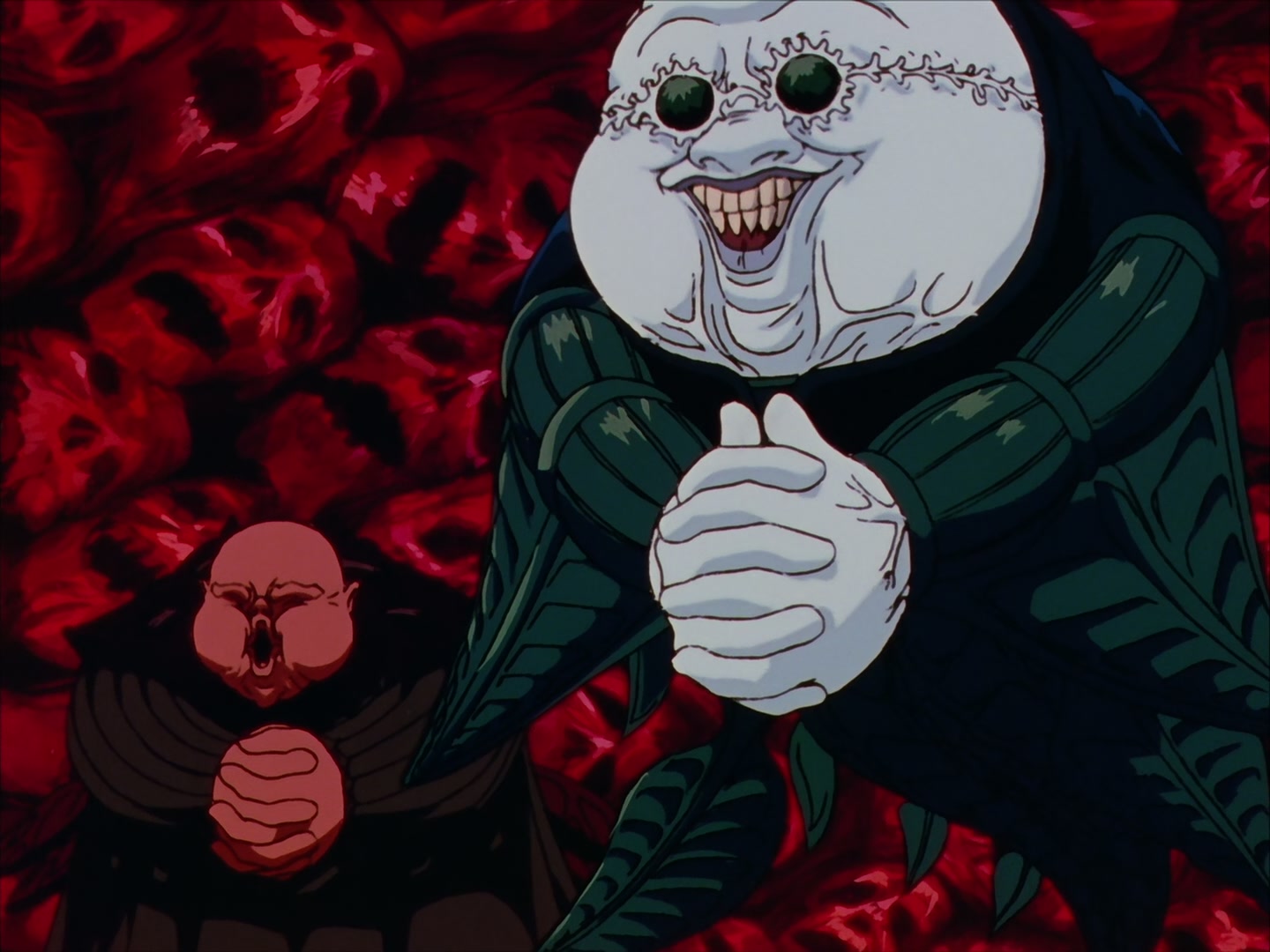
When Tetsuo's bike slams into Takashi (#27), a runaway Esper child with the face of an old man, the impact forcibly unlocks Tetsuo's dormant psionic potential. What follows is not a traditional superhero awakening. It is a terrifying, uncontrollable descent into godhood.

Read more →

Dragon Ball Z - Episode 245: "Super Saiyan 3?!"

Toei Animation looked at that version and said no.
What we got instead is three minutes and thirty-five seconds of Goku screaming while the planet files a noise complaint. Animation supervisor Ichio Hayashi and the episode's key team didn't just produce a transformation sequence. They produced a weather event. The line-weights go dense and frantic. Heavy black shadow floods the close-ups. The animators drew individual pulsing veins on Goku's forehead and micro-reflections inside his contracting irises to sell the physical strain of what he's doing to his own body. The background plates of the rocky wasteland don't just shift. They violently jerk behind him while hand-painted lightning bolts snap across the frame on two-frame intervals. The entire sequence is animated like the earth itself is trying to get away from what's happening.

Read more →